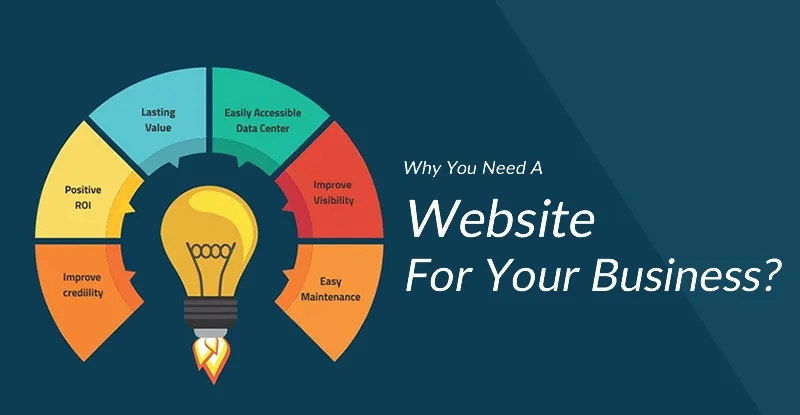
Does your business still need a website? It's a fair question. AI tools, social media, and online marketplaces now drive how customers discover brands — and for many businesses, a website can feel like effort that no longer pays off.
The opposite is true. Social platforms are rented ground — crowded, algorithm-driven, and quick to charge you for the visibility you once got free. A website is land you own. And when it comes to credibility, SEO, and growth that compounds over years, ownership changes everything.
Why Owning a Website Matters More Than Ever?
Social media and AI discovery tools are built on rented ground. Algorithms shift, reach rises and falls, and a platform can restrict, monetise, or pull your content with little warning. They're useful for reach — but they can't replace something you actually own.
A website gives you full control — over your branding, your messaging, how your site works, and the experience customers have. You decide how content appears, how data is captured and used, and how people find and engage with your business. That control is what makes growth predictable, rather than leaving it to platforms you don't govern. This isn't an argument against AI and social media. They matter — but they're most powerful as extensions of your website, not substitutes for it.
Websites Build Trust and Credibility
AI doesn't create content from thin air. It summarises what's already written about you — by you or by someone else — across the web. And if you're a small business or a startup, the truth is that no one else is writing about you. That makes it essential to write, publish, and control your own narrative. As tools like Gemini, Perplexity, ChatGPT, Claude, and Grok change how people search, the fundamental holds: your website is the heart of your digital presence.
It's also what those tools lean on. When AI cites a source or recommends a business, it favours information that's well-structured and corroborated by credible mentions elsewhere — which is to say, the same things that make a business legitimate to a human make it legible to AI. Your own site is the strongest of those signals, because everything else points back to it.
And it isn't only machines that check. However much AI and social media put out, customers still turn to a company's own website for the clear, authoritative version — straight from the source. A well-kept site reads as credible, stable, and established.
That's what a website finally is: your single source of truth, where customers, partners, and even AI tools confirm who you are, what you do, and how to reach you. Social profiles can't offer that depth.
Get in Touch with Us one
Have questions or need more information? Reach out to our team and we'll help you with your next project.
E-Commerce: How websites still play a key role in the purchase journey
Discovery and purchase aren't the same step — and the website owns the middle. People find you on social, marketplaces, AI answers, or search. But between finding you and choosing you sits a verification step: are these people real, credible, and right for what I need? That checking lands on your website, because it's the only place with the depth to answer.
Platforms are shallow by design — a few images, a price, some reviews. Enough to spark interest, not to close serious consideration. The website holds what the decision needs: full specifications, case studies, proof, your story. For an impulse buy, the platform is enough. For anything considered, the buyer leaves it to verify on your site first.
And as buying fragments across more channels, this matters more, not less. The path is no longer "see ad → visit site → buy." Someone might see you on Instagram, read an AI answer, check a marketplace, then your site, then enquire weeks later. The more scattered the journey, the more you need one stable, owned place that ties it together — the hub everything else points back to.
There's an ownership layer too. When the sale happens on a marketplace, the marketplace owns the customer, the data, and the terms — and takes a cut. Your website is where you keep the relationship directly. Even in pure e-commerce, it isn't just a catalogue. It's how the customer stays yours, not rented.
The future of websites in the age of AI
The future isn't AI replacing websites. It's AI raising the value of being the source — and the only source you fully own is your website.
Everything points back to one place. AI doesn't invent what it says about you; it summarises what exists — and if you haven't written it, either no one has, or someone else has, on terms you don't control. Customers still leave the feed to verify you somewhere with real depth. Buyers research on your site before they ever enquire, whatever channel they arrived from. And when AI cites or recommends a business, it leans on the clearest, most authoritative source it can find. In every one of those moments, the website is the thing being read from.
That's the shift worth understanding. A website used to be the destination — the place you drove people to. Now it's increasingly the source the answers are built from, the ground everything else references. Social platforms, marketplaces, AI tools — these are powerful, and they're not going away. But they're extensions of your website, not replacements for it. You build on land you own and use the rest to point people home.
Which is exactly why a website is never finished. The better, clearer, and more structured it gets, the better every other channel works — because they all draw from it. A thin or neglected site means AI has little to go on, customers find little to trust, and the narrative about you gets written by everyone except you. A well-kept one compounds: it earns trust with humans and legibility with machines at the same time, because those are now the same thing.
So build a website — or keep improving the one you have. Not because it's a digital brochure to tick off a list — but because it's the one asset that gets more valuable as everything around it gets noisier. In a world of rented attention, owning your source isn't optional. It's the whole advantage.
Websites aren't going anywhere. If anything, they matter more than ever.